
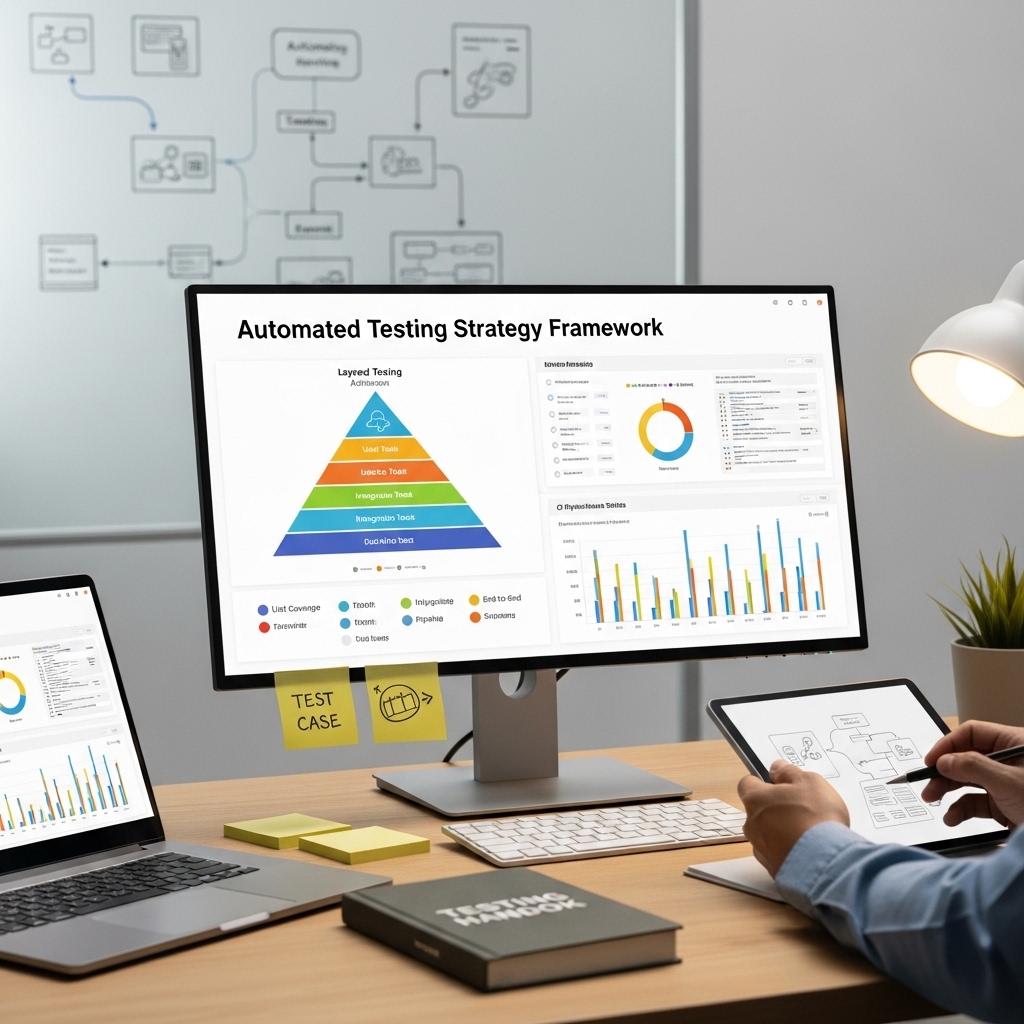


Automated Testing Strategy Framework
🧪 A Test Suite That Doesn’t Prevent Regressions Is a Ceremony, Not a Safety Net
Most software teams have a test suite. Considerably fewer have a test strategy: a coherent, deliberate set of decisions about what to test, at what level, with what tools, with what coverage targets, organized into a maintainable pyramid that provides confidence proportional to the cost of running it. The difference between these two states is a test suite that engineers trust and maintain vs. one that is full of ignored failures, takes 45 minutes to run, is never updated to reflect the code it’s supposed to cover, and has gradually transitioned from a safety mechanism into a bureaucratic hurdle that everyone works around.
The Automated Testing Strategy Framework is the most comprehensive digital resource available for software engineering teams who want to build a testing practice that is strategically designed rather than accidentally accumulated. It covers the full strategic and operational landscape of automated testing: pyramid design, coverage philosophy, toolchain selection and configuration, test authoring standards, CI/CD integration, flakiness management, and the organizational practices that make a testing culture sustainable rather than gradually eroding under feature pressure.
📦 Complete Digital Download Contents
Digital-only. Instant access. Everything included:
Testing Strategy Design Guide (.pdf, 42 pages) A complete methodology for designing a testing strategy from the ground up, covering:
Section 1: Testing Pyramid Theory and Practice (10 pages) The case for a stratified testing strategy, with depth on why the pyramid proportions matter: the cost-of-feedback relationship (unit tests run in milliseconds, end-to-end tests run in minutes, and the cost of fixing a defect found in each environment), the fragility relationship (tests that touch more of the system are more likely to fail for reasons unrelated to the behavior being tested), and the maintenance burden relationship (end-to-end tests require more infrastructure, are harder to isolate failures in, and are more expensive to update). Covers modern variations on the classic pyramid: the testing trophy shape appropriate for certain React/UI testing philosophies, the honeycomb appropriate for microservice architectures, and the testing ice cream cone anti-pattern and how it develops. Each shape is assessed for appropriate use cases rather than presented as universally correct.
Section 2: Unit Testing Strategy (8 pages) What to unit test and what not to. Covers: the behavior-not-implementation testing principle (tests that test the public interface rather than the implementation details survive refactors; tests that test implementation details don’t), test granularity decisions (function-level, class-level, module-level unit tests and when each is appropriate), test isolation methodology (mocking philosophy: what to mock, what not to mock, and the specific risk of over-mocking that produces tests which pass when behavior is broken), boundary testing discipline (why edge cases deserve proportionally higher test investment), and the law of demeter’s impact on testability (code that is designed for testability and code that is designed without testability in mind have very different unit testing characteristics).
Section 3: Integration Testing Strategy (8 pages) Testing the boundaries between components. Covers: what integration tests should and shouldn’t test (behavior at service boundaries, not the behavior already covered by unit tests), test doubles for external services (when to use a real database vs. an in-memory database vs. a mocked database connection), contract testing as an integration testing approach for microservice boundaries (Pact and similar tools), database integration test patterns, API integration test patterns (testing your own API surface), and the specific challenges of testing event-driven system integration.
Section 4: End-to-End Testing Strategy (8 pages) Defining the appropriate role and scope of end-to-end tests. Covers: what E2E tests should exclusively cover (critical user journeys that cannot be adequately covered at a lower test level), the anti-pattern of using E2E tests as the primary confidence mechanism, E2E test environment management, the specific challenges of asynchronous operations in E2E testing, flakiness as an E2E-specific challenge and mitigation strategies, and the maintenance discipline that keeps an E2E suite valuable rather than becoming an abandoned liability.
Section 5: Coverage Strategy (8 pages) How to think about test coverage targets. Covers: line coverage vs. branch coverage vs. mutation testing as fundamentally different coverage signals, the diminishing returns curve of coverage percentage (why 100% line coverage is not 100% confidence), coverage as a floor vs. coverage as a ceiling, the specific code areas where coverage investment has the highest return (business logic, error handling, boundary conditions), how to use coverage data to identify testing gaps rather than to celebrate coverage numbers, and mutation testing as a coverage quality tool.
Section 6: Testing in CI/CD Pipelines (8 pages) Integrating testing into automated build and deployment pipelines. Covers: test parallelization strategies for fast pipeline feedback, test result caching (what can be cached safely and what can’t), pipeline test stage design (when to fail fast vs. run all tests), testing in deployment pipelines (smoke tests after deployment, canary test suites), and the specific CI/CD configuration patterns that make test pipelines reliable rather than flaky.
Test Authoring Standards and Pattern Library (.md + code files, multi-language) A comprehensive collection of test authoring standards and annotated example tests covering the most important testing patterns in three languages:
Python Testing Standards and Pattern Library Coverage includes: pytest project structure (conftest.py architecture, fixture scope hierarchy, plugin configuration), fixture design patterns (database fixtures, external service fixtures, application factory fixtures), parametrize patterns for data-driven testing, mock and patch patterns with unittest.mock and pytest-mock (including the common misuse patterns that produce tests which pass incorrectly), factory_boy integration for test data generation, snapshot testing with syrupy, async test patterns, property-based testing with hypothesis, and mutation testing with mutmut configuration.
JavaScript/TypeScript Testing Standards and Pattern Library Coverage includes: Jest project configuration for TypeScript, React Testing Library component testing patterns (what to query for, what not to query for, the guiding principle of testing user-visible behavior), user event simulation vs. fireEvent (and why the distinction matters), async testing patterns with waitFor and findBy queries, module mocking patterns (the difference between jest.mock and manual mocks and when each is appropriate), MSW (Mock Service Worker) for API mocking in integration tests, Playwright E2E testing patterns (page object model implementation, locator strategy, assertion patterns, and network interception), and Vitest configuration as a Jest alternative.
Go Testing Standards and Pattern Library Coverage includes: testing package patterns, table-driven test design, test helper patterns, testing.T subtests, test fixtures and golden files, mock generation with mockery, integration test build tags pattern, HTTP handler testing with net/http/httptest, database testing with testcontainers-go, and fuzzing test patterns.
CI/CD Test Integration Templates (.yaml, 8 pipeline configurations) Eight complete CI/CD pipeline configuration files for testing integration:
- GitHub Actions: parallel test matrix, test result caching, coverage reporting with codecov, and PR status check integration
- GitHub Actions: E2E test workflow with containerized dependencies (Playwright + Docker Compose)
- GitLab CI: test stage with artifacts, coverage visualization, and merge request pipeline
- GitLab CI: scheduled nightly full-test-suite runner
- CircleCI: test parallelization with test splitting
- Jenkins: Declarative Pipeline with test stages and post-stage reporting
Test Flakiness Management System (.xlsx + .md) A structured system for tracking and eliminating test flakiness:
- Flaky Test Register (.xlsx): Tracking log for all known flaky tests with: test name, failure frequency, observed failure mode, probable cause category (timing, concurrency, external dependency, test isolation, environment), investigation status, and remediation action
- Flakiness Root Cause Taxonomy: Documented categories of test flakiness causes with investigation approaches and remediation patterns for each
- Flaky Test Quarantine Process (.md): A documented process for quarantining a flaky test to prevent it from blocking CI without losing the test entirely, including the re-qualification criteria for restoring a quarantined test to the main suite
Testing Culture and Process Guide (.pdf, 22 pages) The organizational practices that determine whether a testing strategy succeeds or fails, covering: test authoring as part of definition-of-done (how to make testing a first-class engineering activity rather than a post-development obligation), code review standards for test quality (what reviewers should check in test code that they would not check in production code), handling the “I’ll write tests later” pattern constructively, testing culture in legacy codebases (how to improve test coverage gradually without a full rewrite), and how to frame the testing investment to engineering leadership and product stakeholders using defect rate data and deployment confidence metrics.
📂 What Downloads to Your Device
📖 Testing Strategy Design Guide (.pdf, 42 pages) — Complete pyramid theory, unit/integration/E2E/coverage strategy, and CI/CD integration methodology 💻 Test Authoring Standards and Pattern Library (code files) — Python, TypeScript/JavaScript, and Go testing pattern collections with annotated examples ⚙️ CI/CD Test Integration Templates (.yaml, 8 configurations) — GitHub Actions, GitLab CI, CircleCI, and Jenkins pipeline templates 🩺 Test Flakiness Management System (.xlsx + .md) — Flaky test register, root cause taxonomy, and quarantine process 🏗️ Testing Culture and Process Guide (.pdf, 22 pages) — Organizational practices for sustainable testing culture

Reviews
There are no reviews yet.